
ARTICLE IN ENGLISH –
CHECK OUT THE VIDEO –
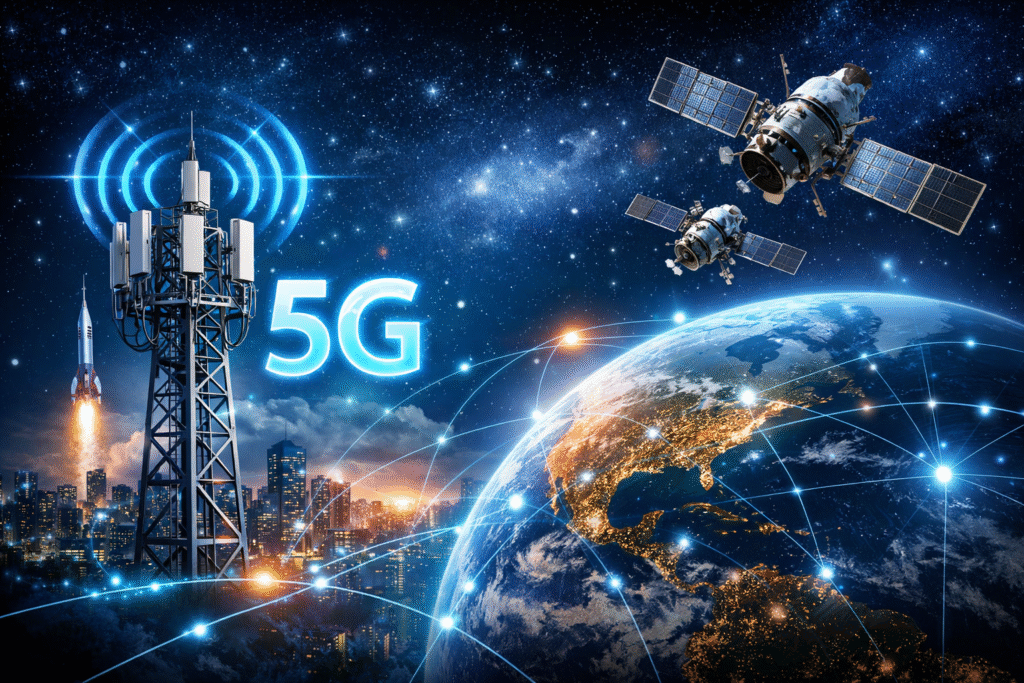
5G and satellites global connectivity is no longer a futuristic concept. It is a reality that is actively reshaping how people, businesses, and governments connect across the planet. From densely populated cities to the most remote regions, these technologies are redefining digital access, speed, and reliability.
The convergence of 5G networks and satellite communication systems represents a structural shift in global digital infrastructure. Together, they are closing connectivity gaps, enabling new economic models, and transforming everyday digital experiences.
Why is global connectivity becoming a strategic priority?
In today’s digital economy, connectivity is no longer a luxury. It is a critical resource that supports education, healthcare, commerce, security, and innovation. Governments and corporations now recognize that digital inclusion directly influences economic growth and social development.
However, traditional terrestrial networks alone cannot meet global demand. This is where the combination of 5G and satellite technologies becomes essential.
Understanding 5G technology and its global impact
What makes 5G different from previous generations?
5G technology represents a major leap forward compared to 3G and 4G networks. It is designed to deliver ultra-fast speeds, ultra-low latency, and massive device connectivity.
- Higher data speeds enabling real-time applications
- Low latency critical for autonomous systems and remote operations
- Massive connectivity for IoT and smart environments
These capabilities make 5G the backbone of modern digital ecosystems, supporting smart cities, connected vehicles, and immersive technologies.
How does 5G support economic and technological growth?
By enabling faster and more reliable communication, 5G drives productivity across industries. Manufacturing, logistics, healthcare, and finance all benefit from real-time data exchange and automation.
More importantly, 5G creates opportunities for innovation by supporting technologies such as artificial intelligence, augmented reality, and edge computing.
The role of satellites in global connectivity
Why are satellites essential for global coverage?
Despite advances in terrestrial networks, vast areas of the world remain underserved. Mountains, oceans, deserts, and rural regions present physical and economic barriers to traditional infrastructure.
Satellite internet overcomes these limitations by providing coverage independent of ground-based networks. Modern low Earth orbit (LEO) satellites offer significantly improved speed and reduced latency compared to older systems.
Key advantages of satellite connectivity
- Global reach, including remote and isolated regions
- Rapid deployment without extensive infrastructure
- Resilience during natural disasters or network failures
These advantages make satellites a critical component of a truly global communication network.
How 5G and satellites work together
Is integration the future of global networks?
The real transformation occurs when 5G and satellite systems are integrated into a unified connectivity framework. Rather than competing, these technologies complement each other.
5G excels in urban and high-density environments, while satellites extend coverage to areas where terrestrial networks are impractical. This hybrid approach ensures continuous and reliable connectivity worldwide.
Practical examples of 5G and satellite integration
- Connected transportation systems across land, sea, and air
- Remote healthcare and telemedicine services
- Disaster response and emergency communications
- Global IoT networks for agriculture and environmental monitoring
These use cases demonstrate how 5G and satellites global connectivity supports both everyday services and mission-critical operations.
Impact on businesses and digital markets
How does enhanced connectivity change business models?
Reliable global connectivity enables companies to operate beyond geographical limitations. Businesses can reach new markets, optimize supply chains, and deliver digital services at scale.
Cloud-based platforms, remote work, and data-driven decision-making all depend on fast and stable networks. As a result, connectivity becomes a competitive advantage.
Opportunities created by next-generation networks
- Expansion of digital services into emerging markets
- Growth of data-intensive applications
- Increased efficiency through automation and real-time analytics
These opportunities highlight the economic significance of investing in advanced connectivity infrastructure.
Social and environmental implications
Can global connectivity reduce digital inequality?
One of the most important benefits of combining 5G and satellite technology is the potential to reduce the digital divide. Access to reliable internet supports education, healthcare, and financial inclusion.
Remote learning, telemedicine, and digital public services become accessible to populations previously excluded from the digital world.
Environmental considerations and sustainability
While expanding connectivity raises concerns about environmental impact, modern systems are increasingly designed with efficiency in mind. Improved network performance reduces energy consumption per transmitted data unit.
Additionally, satellite-based monitoring supports environmental protection by enabling climate observation and resource management.
Challenges and limitations to consider
What obstacles still exist?
Despite significant progress, challenges remain. Regulatory frameworks, spectrum allocation, and infrastructure costs can slow deployment. Security and data privacy also require continuous attention.
However, ongoing technological advancements and international cooperation are steadily addressing these issues.
Frequently Asked Questions (FAQ)
What is meant by 5G and satellites global connectivity?
It refers to the combined use of 5G networks and satellite systems to provide seamless, high-quality internet access worldwide.
Can satellite internet match 5G speeds?
Modern satellite systems offer competitive speeds, especially in areas without terrestrial infrastructure, though performance may vary by location.
Who benefits the most from this technology?
Remote communities, global businesses, emergency services, and industries relying on real-time data benefit significantly.
Is this technology already in use?
Yes. Many regions already use integrated 5G and satellite solutions for communication, transportation, and public services.
Will this replace traditional networks?
No. It is designed to complement existing networks, not replace them.
Conclusion: the future of global connectivity
5G and satellites global connectivity is transforming the digital landscape by making communication faster, more inclusive, and more resilient. Together, these technologies create a flexible infrastructure capable of supporting future innovation.
As adoption continues, their combined impact will extend beyond technology, influencing economies, societies, and global cooperation. Understanding this transformation is essential for anyone navigating the digital era.
COPYRIGHT NOTICE.

This video was embedded from YouTube and is licensed under Creative Commons (CC BY), which permits its reuse.

Credit to the original author as required by the license.