
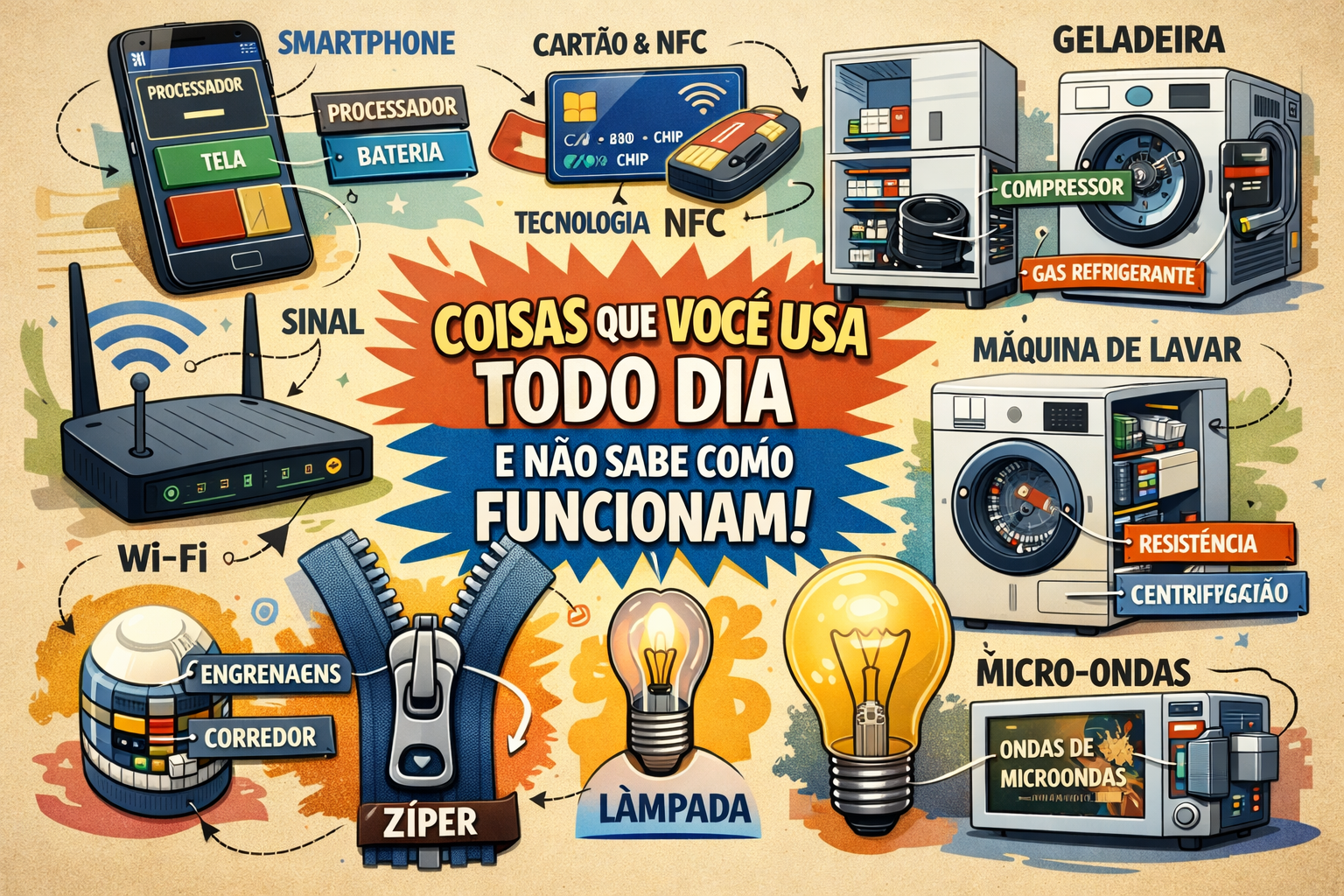

Every day, we rely on dozens of objects and technologies without giving much thought to how they actually function. From the moment you wake up to the time you go to bed, invisible systems, complex engineering, and brilliant scientific principles are quietly working in the background. This article reveals the fascinating mechanics behind common everyday things you use daily — often without realizing how extraordinary they truly are.
Understanding how everyday objects work not only satisfies curiosity but also deepens your appreciation for modern technology and human innovation. Let’s explore some of the most surprising examples.
How Wi-Fi Really Works
Wi-Fi feels almost magical. You open your device, connect instantly, and access information from across the world. But Wi-Fi is actually based on radio waves — the same type of waves used in televisions and radios.
Invisible Data in the Air
Your router sends data through electromagnetic waves at specific frequencies. These waves travel through walls, furniture, and even people. Your device translates these waves into readable information like videos, emails, and web pages.
The impressive part is how Wi-Fi avoids interference. It constantly switches channels and frequencies to ensure a stable connection, making it one of the most sophisticated everyday technologies.
Touchscreens: How Your Fingers Control Screens
Smartphones and tablets have become extensions of our hands. But how does a screen know exactly where you touched?
Capacitive Technology Explained
Modern touchscreens use capacitive technology. Your finger conducts electricity, and when it touches the screen, it disrupts an electrical field. Sensors detect this change and calculate the precise location of the touch.
This process happens in milliseconds, enabling gestures like zooming, swiping, and typing — all without any physical buttons.
Credit and Debit Cards: Plastic with Powerful Technology
Swiping or tapping a card seems simple, but behind it lies advanced encryption and data transmission.
Magnetic Strips and Chips
The magnetic strip stores your account information, while modern EMV chips create a unique transaction code for each purchase. This dynamic data makes fraud significantly harder.
Contactless payments use Near Field Communication (NFC), allowing secure data exchange over very short distances.
Microwave Ovens: Fast Cooking with Science
Microwaves heat food quickly, but not because they “cook from the inside out,” as many believe.
How Microwaves Heat Food
Microwave ovens emit electromagnetic waves that cause water molecules in food to vibrate rapidly. This vibration creates heat, warming your meal evenly and efficiently.
The rotating plate ensures that waves reach different parts of the food, preventing cold spots.
GPS: Knowing Your Location Anywhere
GPS technology allows your phone or car to pinpoint your location almost anywhere on Earth.
Satellites and Precise Timing
At least 24 satellites orbit the planet, sending time-stamped signals to your device. By calculating the delay between signals from multiple satellites, your location is determined with remarkable accuracy.
This technology relies on atomic clocks and Einstein’s theory of relativity to remain precise.
Automatic Doors: Sensors at Work
Automatic doors open seamlessly as you approach, but how do they know you’re there?
Motion and Pressure Detection
Most automatic doors use motion sensors or pressure-sensitive mats. Motion sensors detect changes in infrared radiation or movement patterns, triggering the door mechanism.
This technology improves accessibility and energy efficiency in public spaces.
Refrigerators: Keeping Food Fresh
Refrigerators don’t generate cold — they remove heat.
The Cooling Cycle
A refrigerant absorbs heat from inside the fridge and releases it outside through coils. This continuous cycle keeps food at safe temperatures, slowing bacterial growth.
It’s a perfect example of applied thermodynamics in everyday life.
Search Engines: How Google Finds Answers
Typing a question into a search engine delivers results in seconds.
Algorithms and Indexing
Search engines scan billions of pages, index their content, and rank them based on relevance, authority, and user experience. SEO plays a critical role in this process.
Advanced algorithms analyze keywords, links, and user behavior to deliver accurate results.
FAQ – Frequently Asked Questions
Why is it important to understand how everyday things work?
Understanding everyday technology enhances critical thinking, encourages curiosity, and helps you make smarter choices as a consumer.
Are everyday technologies becoming more complex?
Yes. While interfaces are simpler, the underlying systems are increasingly advanced and interconnected.
Does knowing how technology works improve digital safety?
Absolutely. Awareness helps protect against fraud, misinformation, and misuse of personal data.
Can learning this help with career development?
Yes. Basic technological literacy is valuable in almost every modern profession.
Conclusion
The objects and technologies you use every day are far more fascinating than they appear. From invisible radio waves to complex algorithms, modern life is powered by brilliant engineering and scientific discovery.
By understanding how common things work, you gain a deeper appreciation for innovation and a stronger connection to the world around you. Stay curious — the ordinary is often extraordinary.
This article was crafted to deliver high-value content optimized for SEO, content marketing, and Google AdSense, ensuring an engaging and informative experience for modern readers.
AVISOS DE DIREITOS AUTORAIS.
Este vídeo foi incorporado do YouTube e está licenciado sob “CREATIVE COMMONS” (CC BY), o que permite sua reutilização.
Créditos ao autor original conforme exigido pela licença.
This video was embedded from YouTube and is licensed under "CREATIVE COMMONS" (CC BY), which allows its reuse.
Credit to the original author as required by the license.