
ARITCLE IN ENGLISH
CHECK OUT THE VIDEO
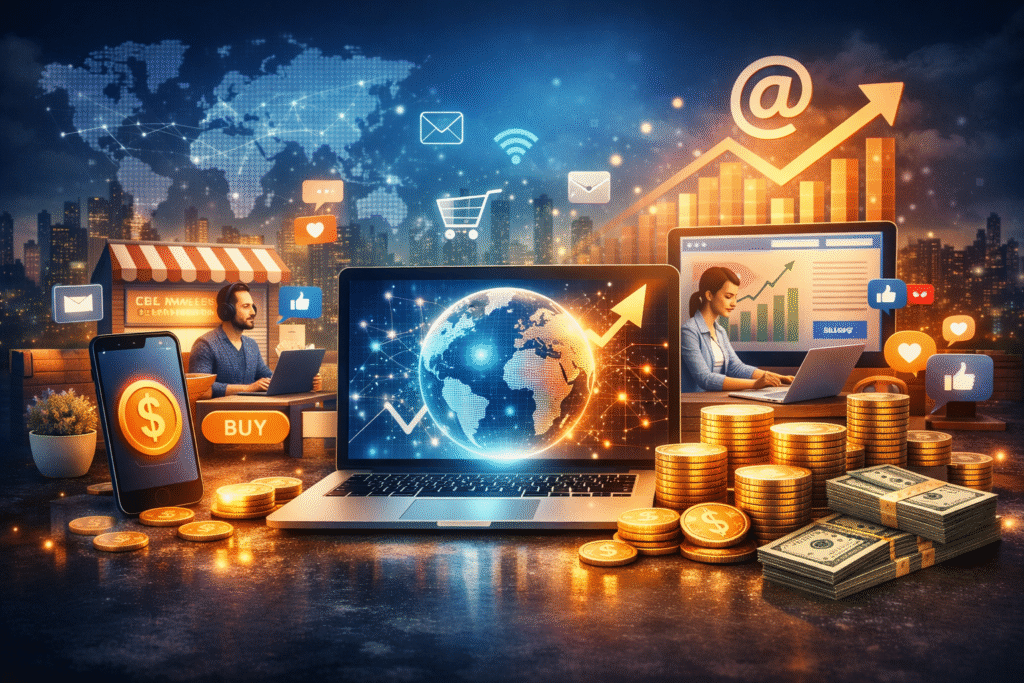
The digital economy has become one of the most transformative forces of the 21st century. Within the first decades of widespread internet adoption, traditional income models have been reshaped, creating new ways to make money online, work remotely, and build scalable digital businesses.
What once depended on physical presence, fixed schedules, and local markets is now increasingly driven by data, platforms, automation, and global connectivity. This shift is not a trend—it is a structural change in how value is created and exchanged.
What is the digital economy and why does it matter?
The digital economy refers to all economic activities enabled or enhanced by digital technologies, especially the internet. It includes online services, digital platforms, e-commerce, remote work, content monetization, and technology-driven business models.
Its relevance lies in its ability to reduce barriers to entry, democratize access to markets, and allow individuals to monetize skills, knowledge, and creativity at scale.
Key characteristics of the digital economy
- Global reach: income opportunities are no longer limited by geography
- Low initial investment: many digital models require minimal upfront capital
- Scalability: digital products and services can grow exponentially
- Data-driven decisions: performance is measured and optimized in real time
How has the internet changed traditional income models?
Before the internet, earning money was strongly tied to fixed employment structures. The rise of the digital economy introduced flexible models where income can come from multiple sources simultaneously.
This transition has redefined concepts such as employment, entrepreneurship, and career stability. Individuals now combine active and passive income streams, often working independently of traditional institutions.
From fixed jobs to flexible income streams
- Freelancing replacing long-term contracts
- Remote work reducing dependence on physical offices
- Digital products replacing physical inventory
- Platforms connecting supply and demand instantly
What are the main ways to make money in the digital economy?
The internet has enabled diverse monetization strategies that fit different skill sets, risk profiles, and time commitments. These models are not mutually exclusive and are often combined for greater financial resilience.
Popular digital income models
- Freelancing and remote services: writing, design, programming, consulting
- Content creation: blogs, videos, podcasts, and social media monetization
- E-commerce and dropshipping: selling physical or digital products online
- Affiliate marketing: earning commissions through referrals
- Online education: courses, mentoring, and digital training programs
Why content creation has become a powerful economic asset
Content is one of the most valuable currencies in the digital economy. Educational, informative, and entertaining content attracts attention, builds trust, and generates monetization opportunities over time.
Blogs, videos, and social platforms allow creators to transform knowledge into recurring revenue while building long-term digital assets.
Monetization channels for digital content
- Advertising networks and display ads
- Sponsorships and brand partnerships
- Affiliate links and recommendations
- Paid memberships and premium content
How digital platforms are reshaping entrepreneurship
Digital platforms have reduced the complexity of starting and scaling businesses. Marketplaces, payment processors, and automation tools allow entrepreneurs to focus on value creation instead of infrastructure.
This environment favors experimentation, rapid validation, and continuous optimization—key advantages over traditional business models.
Examples of platform-driven opportunities
- Online marketplaces connecting sellers and buyers
- Software-as-a-service solutions for niche problems
- Subscription-based digital services
- Creator-focused monetization ecosystems
What skills are most valuable in the digital economy?
Success in the digital economy is less about formal credentials and more about adaptable, market-relevant skills. Continuous learning has become a competitive advantage.
High-demand digital skills
- Digital marketing and SEO optimization
- Data analysis and performance tracking
- Content strategy and storytelling
- Automation and basic programming
- User experience and conversion optimization
Is the digital economy sustainable in the long term?
Despite rapid changes, the digital economy shows strong indicators of long-term sustainability. Its adaptability allows it to evolve alongside new technologies such as artificial intelligence, automation, and decentralized systems.
However, sustainability depends on ethical practices, data responsibility, and continuous skill development.
Frequently Asked Questions about the digital economy
What is the digital economy in simple terms?
It is the part of the economy driven by digital technologies, where the internet enables new ways of working, selling, and generating income.
Can anyone make money in the digital economy?
Yes, but results depend on skills, consistency, and strategic positioning. The barrier to entry is lower, but competition requires differentiation.
Is digital income more stable than traditional jobs?
Digital income can be flexible and scalable, but it often requires diversification to reduce risk and ensure long-term stability.
Do digital businesses require large investments?
Many digital models start with minimal investment, focusing more on knowledge, time, and execution than on physical assets.
How long does it take to see results online?
Timelines vary. Some models generate income quickly, while others—such as content-based strategies—are long-term investments that compound over time.
Conclusion: the future of earning money is digital
The digital economy is redefining how people earn, grow, and sustain income. By leveraging the internet, individuals gain access to global markets, flexible work structures, and scalable opportunities.
Understanding this transformation is no longer optional. Those who adapt, develop relevant skills, and embrace digital strategies are better positioned to thrive in an economy increasingly shaped by technology.
COPYRIGHT NOTICE.

This video has been embedded on YouTube and is licensed under the Creative Commons License (CC BY), which permits its reuse.

Credit to the original author, as required by the license.