
ARTICLE IN ENGLISH –
CHECK OUT THE VIDEO –
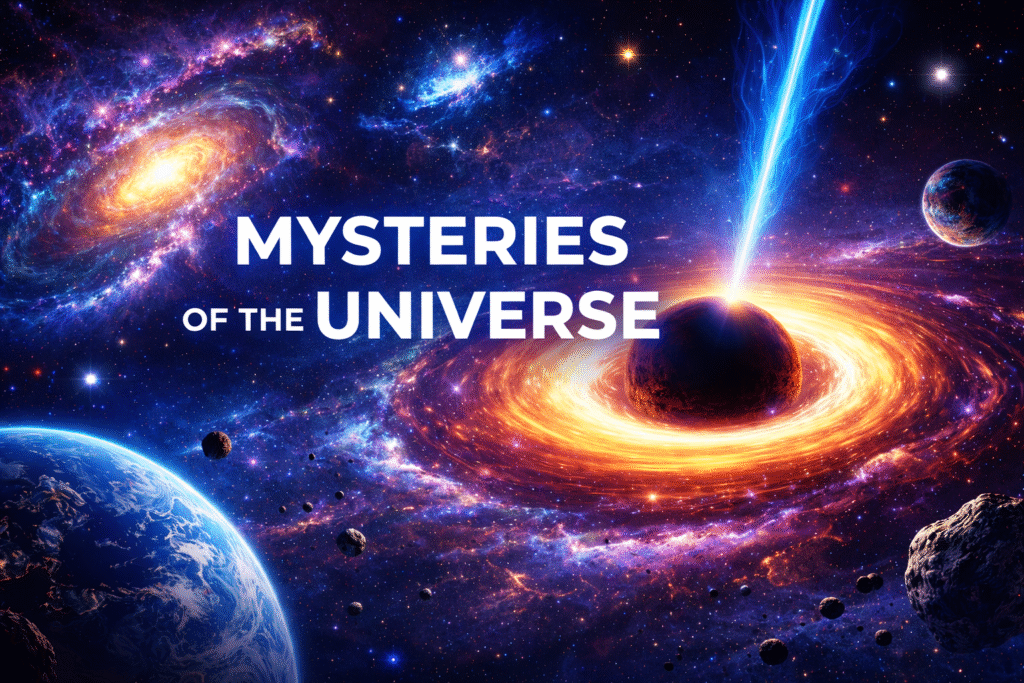
Mysteries of the Universe: Black Holes, Galaxies, and Fascinating Cosmic Phenomena
Mysteries of the Universe have fascinated humanity for centuries, awakening curiosity, fear, and a deep desire to understand what lies beyond our planet. From the invisible pull of black holes to the vast architecture of galaxies and unexplained cosmic events, the universe remains one of the most complex and intriguing subjects in modern science.
As technology advances and space exploration becomes more precise, astronomers continue to uncover discoveries that challenge existing theories and reshape our understanding of reality. This article explores the most compelling cosmic mysteries, explaining them clearly while revealing their scientific, technological, and even economic relevance.
Why Are the Mysteries of the Universe Still Unsolved?
Despite centuries of observation, the universe is largely unknown. Scientists estimate that visible matter represents only a small fraction of what actually exists. The rest is composed of invisible forces and structures that remain difficult to measure or fully understand.
- Extreme distances that limit direct observation
- Cosmic events occurring over millions or billions of years
- Physical laws that behave differently under extreme conditions
- Technological limitations in deep-space exploration
These challenges explain why many cosmic mysteries continue to defy definitive explanations, even with advanced scientific tools.
What Makes Black Holes One of the Greatest Cosmic Mysteries?
Black holes are regions of space where gravity is so intense that nothing, not even light, can escape. They form when massive stars collapse under their own gravitational force, creating a singularity with infinite density.
How Do Black Holes Affect Space and Time?
Black holes distort space-time itself. According to modern physics, time slows dramatically near their event horizon. This phenomenon challenges traditional concepts of time, motion, and causality.
Main Types of Black Holes
- Stellar black holes
- Supermassive black holes at galaxy centers
- Intermediate black holes
- Theoretical primordial black holes
Interestingly, supermassive black holes play a key role in galaxy formation, influencing star movement and cosmic structure.
How Do Galaxies Shape the Structure of the Universe?
Galaxies are massive systems of stars, gas, dust, and dark matter bound by gravity. There are billions of galaxies in the observable universe, each with unique shapes and behaviors.
Types of Galaxies Observed by Astronomers
- Spiral galaxies, like the Milky Way
- Elliptical galaxies
- Irregular galaxies
Galaxies evolve through collisions and mergers, reshaping their structure over cosmic time. These interactions release enormous amounts of energy and trigger star formation.
What Lies at the Center of Most Galaxies?
At the heart of nearly every large galaxy lies a supermassive black hole. Rather than destroying galaxies, these objects help regulate their growth by controlling gas flow and star creation.
What Are the Most Fascinating Cosmic Phenomena Ever Observed?
Beyond black holes and galaxies, the universe hosts extraordinary phenomena that stretch the limits of scientific explanation.
Cosmic Phenomena That Challenge Science
- Gamma-ray bursts: the most powerful explosions known
- Fast radio bursts: brief but intense radio signals from deep space
- Dark matter: invisible mass shaping galaxies
- Dark energy: force driving the universe’s expansion
These occurrences offer clues about the fundamental laws governing space, matter, and energy.
How Do Space Mysteries Influence Technology and Society?
The study of cosmic mysteries extends far beyond academic curiosity. Space research drives innovation in multiple sectors, including computing, materials science, communication, and artificial intelligence.
Practical Impacts of Space Research
- Satellite technology and global communication
- Medical imaging and diagnostic tools
- Advanced data analysis and algorithms
- Navigation systems and Earth monitoring
Understanding the universe also shapes philosophical perspectives, influencing how humanity views its place in existence.
Can Studying the Universe Create Economic Opportunities?
Modern space exploration has become a strategic industry. Governments and private companies invest heavily in astronomy, space missions, and related technologies.
This growing space economy generates jobs, innovation, and commercial opportunities while expanding scientific knowledge.
Frequently Asked Questions About the Mysteries of the Universe
Are black holes dangerous to Earth?
No. The nearest known black holes are far too distant to pose any threat to our planet.
Is the universe infinite?
Current observations suggest the universe is expanding, but whether it is infinite remains unknown.
What is dark matter made of?
Scientists have not yet identified its composition, but its gravitational effects are well documented.
Can humans travel beyond our galaxy?
With current technology, intergalactic travel remains theoretical and impractical.
Why is space exploration still important?
It expands scientific knowledge, drives innovation, and helps humanity understand long-term survival.
Conclusion: Why the Mysteries of the Universe Still Matter
The mysteries of the universe continue to inspire science, innovation, and human imagination. Black holes, galaxies, and unexplained cosmic phenomena challenge existing knowledge while opening new paths for discovery.
As technology evolves, future generations may solve questions that seem impossible today. Until then, exploring the universe remains one of humanity’s greatest intellectual and scientific pursuits, shaping not only our understanding of space but also our vision of the future.
COPYRIGHT NOTICE.

This video was embedded from YouTube and is licensed under Creative Commons (CC BY), which permits its reuse.

Credit to the original author as required by the license.