
ARTICLE IN ENGLISH –
CHECK OUT THE VIDEO –
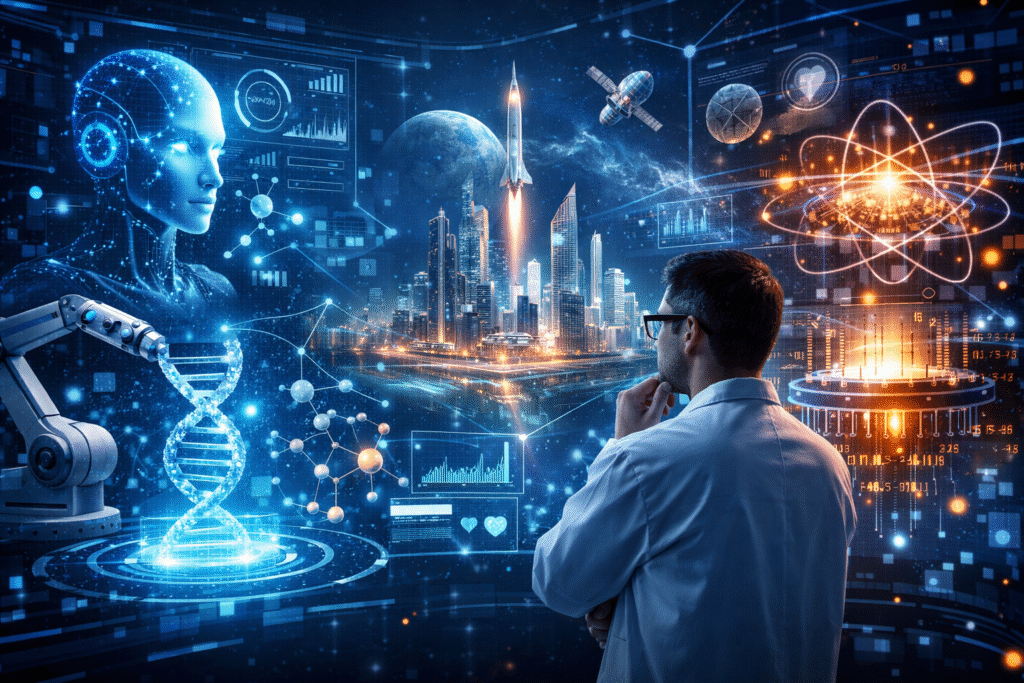
Scientific and technological advances shaping the future of humanity
Scientific and technological advances are reshaping the future at an unprecedented pace, redefining how societies operate, economies grow, and individuals live, work, and connect. From artificial intelligence to biotechnology, innovation is no longer incremental—it is transformative, systemic, and global.
Understanding these changes is not optional. It is essential for professionals, businesses, policymakers, and anyone seeking relevance in a rapidly evolving world.
Why are scientific and technological advances accelerating so fast?
The speed of innovation today is driven by the convergence of multiple technologies, massive data availability, global collaboration, and exponential computing power. Unlike previous industrial revolutions, modern progress feeds on itself.
- Increased investment in research and development
- Global access to digital infrastructure
- Automation of discovery processes
- Interdisciplinary collaboration across fields
This acceleration is not just about faster tools, but about smarter systems capable of learning, adapting, and optimizing in real time.
How is artificial intelligence redefining decision-making?
Artificial intelligence (AI) has evolved from experimental algorithms into a foundational technology influencing nearly every sector. Its impact extends far beyond automation.
From data analysis to predictive intelligence
Modern AI systems process vast datasets, identify complex patterns, and generate insights with remarkable accuracy. This capability supports:
- Medical diagnostics and personalized treatments
- Financial risk assessment and fraud detection
- Supply chain optimization and logistics forecasting
- Climate modeling and environmental monitoring
The shift from reactive decisions to predictive strategies is one of the most profound changes AI introduces.
Ethical and social implications of AI growth
As AI systems gain autonomy, ethical considerations become central. Transparency, accountability, and fairness are now integral parts of technological development, influencing regulation and public trust worldwide.
What breakthroughs in biotechnology are changing human health?
Biotechnology stands at the intersection of science, medicine, and engineering. Recent advances are extending life expectancy and improving quality of life.
Genetic engineering and precision medicine
Technologies like gene editing enable targeted treatments tailored to individual genetic profiles. This approach reduces side effects and increases therapeutic effectiveness.
Regenerative medicine and bioengineering
Lab-grown tissues, organ regeneration, and advanced prosthetics are transforming healthcare delivery, offering solutions to previously irreversible conditions.
These scientific and technological advances are shifting medicine from treatment-focused to prevention-oriented systems.
How is quantum computing changing technological limits?
Quantum computing introduces a new computational paradigm, capable of solving problems that classical computers cannot efficiently address.
Solving complex problems at unprecedented speed
Applications include molecular simulations, cryptography, financial modeling, and materials science. Industries reliant on complex optimization stand to gain substantial advantages.
Long-term impact on cybersecurity and encryption
While quantum systems pose challenges to current encryption standards, they also enable the creation of more secure communication protocols, reshaping digital security.
Can renewable energy technologies secure a sustainable future?
Energy innovation is central to addressing climate challenges. Scientific progress is making renewable solutions more efficient, scalable, and economically viable.
- Advanced solar and wind technologies
- High-capacity energy storage systems
- Smart grids powered by AI
- Hydrogen-based energy solutions
These technologies reduce dependence on fossil fuels while supporting economic growth and energy resilience.
How are space technologies expanding human possibilities?
Space exploration is no longer limited to national agencies. Private-sector innovation has accelerated advancements in satellite systems, launch technologies, and space-based research.
Satellite networks and global connectivity
Low-orbit satellite constellations are improving internet access, disaster response, and environmental monitoring across remote regions.
Scientific research beyond Earth
Microgravity research enables breakthroughs in materials science, medicine, and physics that are difficult to achieve on Earth.
What role does automation play in the future of work?
Automation is transforming labor markets by redefining tasks rather than eliminating jobs outright. Routine activities are increasingly automated, while human roles shift toward creativity, strategy, and oversight.
Reskilling and lifelong learning
Continuous education becomes essential as technology reshapes skill demands. Organizations investing in workforce development gain long-term competitiveness.
Scientific and technological advances in everyday life
Beyond industry and research, innovation directly affects daily experiences—from smart homes and wearable health devices to personalized digital services.
These changes enhance efficiency, accessibility, and quality of life while raising important questions about privacy and digital well-being.
Frequently Asked Questions (FAQ)
What are the most important scientific and technological advances today?
Artificial intelligence, biotechnology, quantum computing, renewable energy systems, and space technologies are among the most influential developments shaping the future.
How do technological advances impact the global economy?
They drive productivity, create new markets, transform labor structures, and redefine competitive advantages across industries.
Are scientific advances always beneficial?
While they offer significant benefits, responsible governance and ethical frameworks are essential to mitigate risks and unintended consequences.
How can individuals prepare for technological change?
Developing digital literacy, adaptability, and critical thinking skills is key to staying relevant in a technology-driven world.
Will technology replace human decision-making?
Technology enhances decision-making but does not replace human judgment. The most effective systems combine computational intelligence with human insight.
Conclusion: understanding progress to shape the future
Scientific and technological advances are not distant concepts—they are active forces shaping economies, societies, and individual lives. Their influence will continue to expand, creating opportunities and challenges in equal measure.
By understanding these developments, stakeholders can make informed decisions, anticipate change, and contribute responsibly to a future defined not only by innovation, but by purpose, sustainability, and human-centered progress.
COPYRIGHT NOTICE.

This video was embedded from YouTube and is licensed under Creative Commons (CC BY), which permits its reuse.

Credit to the original author as required by the license.