
ARTICLE IN ENGLISH –
CHECK OUT THE VIDEO –
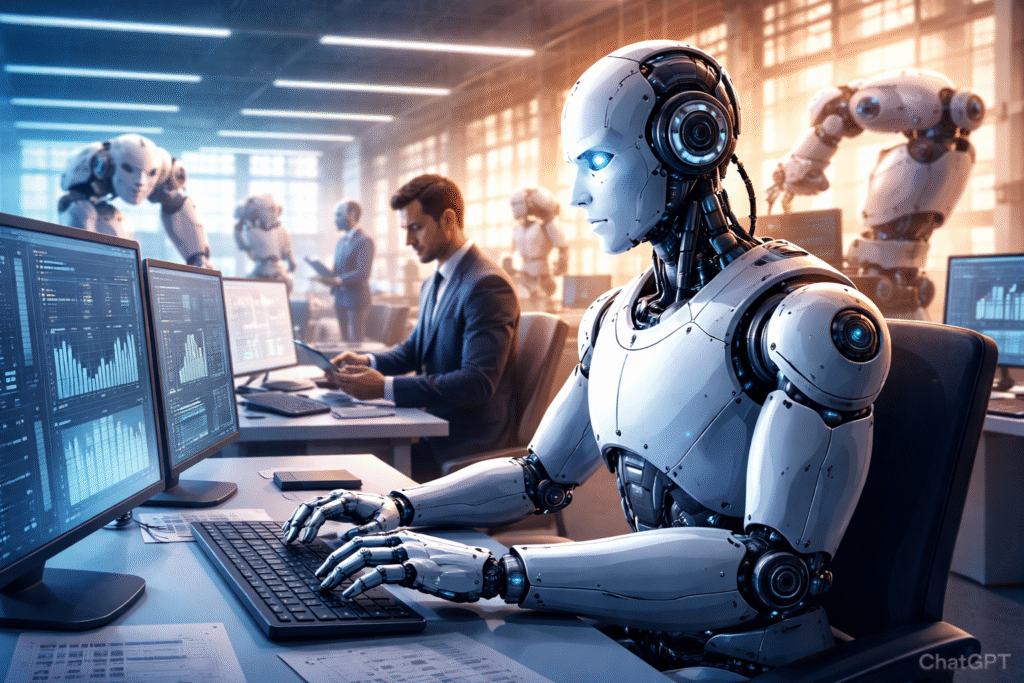
Robots Transforming the Job Market: The Silent Revolution Reshaping Work
Robots transforming the job market is no longer a futuristic prediction—it is a measurable, accelerating reality. Across factories, hospitals, warehouses, and even offices, intelligent machines are quietly assuming tasks once performed exclusively by humans.
This silent revolution is not defined by dramatic headlines but by gradual, strategic integration. Companies are automating processes to increase efficiency, reduce costs, and enhance precision. Workers, in turn, are adapting to a rapidly evolving employment landscape.
This in-depth analysis explores how automation in the workplace is reshaping industries, which jobs are most affected, what new opportunities are emerging, and how professionals can stay competitive in the future of work.
Why Is Automation Accelerating Now?
The expansion of robotics in industry is not happening randomly. It is driven by converging technological and economic factors.
Technological Maturity and Falling Costs
Robotics hardware has become more affordable, while artificial intelligence systems have grown more sophisticated. Machine learning algorithms allow robots to:
- Recognize patterns in real time
- Adapt to changing environments
- Perform complex decision-making tasks
- Collaborate safely with humans (cobots)
What once required massive capital investment is now accessible to mid-sized businesses.
Global Competition and Productivity Pressure
In a highly competitive global market, companies must maximize output while controlling operational costs. Automation increases:
- Production speed
- Operational accuracy
- 24/7 productivity without fatigue
- Quality consistency
The result is a strong financial incentive to integrate robotics into core operations.
Which Industries Are Most Affected by Robotics?
The impact of robotics on employment varies by sector. Some industries are undergoing radical transformation, while others are experiencing gradual shifts.
Manufacturing and Industrial Production
This sector leads the automation movement. Industrial robots handle repetitive and hazardous tasks such as welding, assembly, packaging, and material handling.
Impact:
- Reduction of manual assembly roles
- Increase in robotics maintenance and programming jobs
- Improved workplace safety
Logistics and Warehousing
Autonomous mobile robots optimize inventory management, sorting, and delivery preparation.
Distribution centers now rely on robotic systems to:
- Track inventory in real time
- Reduce human error in picking processes
- Accelerate shipping timelines
The transformation is less about eliminating workers and more about redefining their responsibilities.
Healthcare and Medical Robotics
Robotic-assisted surgery, automated diagnostics, and AI-supported imaging analysis are enhancing precision in healthcare.
Rather than replacing professionals, these systems augment medical expertise, improving outcomes and reducing procedural risks.
Service and Customer Interaction
Chatbots, AI-driven support systems, and automated kiosks are transforming customer service. Routine inquiries are increasingly handled by intelligent systems, allowing human agents to focus on complex cases.
Are Robots Replacing Human Jobs?
This is one of the most searched and debated questions regarding job automation impact.
The Reality: Replacement and Creation Happen Simultaneously
Yes, certain roles—especially repetitive, rule-based tasks—are declining. However, history shows that technological revolutions also generate new job categories.
Examples of emerging roles include:
- Robotics engineers and technicians
- AI ethics specialists
- Automation process analysts
- Data science professionals
- Human-machine interaction designers
The workforce transformation is not a zero-sum game. It is a structural shift toward higher-value skills.
What Skills Will Define the Future of Work?
As robots assume operational tasks, human value increasingly centers on uniquely human capabilities.
Technical and Digital Fluency
Understanding data systems, automation workflows, and AI tools is becoming foundational—even outside the tech sector.
Creative and Strategic Thinking
Robots execute; humans innovate. Strategy, problem-solving, and conceptual thinking remain difficult to automate.
Emotional Intelligence and Leadership
Empathy, negotiation, and team coordination are critical in hybrid workplaces where humans and machines collaborate.
The future of work favors adaptability over routine specialization.
Common Myths About Robots and Employment
“All Jobs Will Disappear”
This narrative oversimplifies economic evolution. While job displacement occurs, entire industries also expand due to increased productivity.
“Automation Only Affects Low-Skill Jobs”
Automation impacts both blue-collar and white-collar sectors. Even finance, legal research, and marketing use AI-driven systems today.
“Robots Work Independently of Humans”
In reality, most automation systems require oversight, programming, and maintenance. Human supervision remains essential.
How Businesses Are Strategically Integrating Robotics
Successful organizations approach automation as a long-term transformation strategy rather than a cost-cutting shortcut.
Gradual Implementation
Companies often begin with pilot programs in specific departments before scaling automation company-wide.
Employee Reskilling Programs
Forward-thinking corporations invest in training initiatives to prepare workers for new roles within automated ecosystems.
Human-Robot Collaboration Models
Collaborative robots (cobots) are designed to work alongside humans, enhancing productivity without fully replacing staff.
This balanced integration minimizes disruption and maximizes value creation.
Economic and Social Implications
The expansion of robotics raises important macroeconomic and ethical considerations.
Income Inequality and Skill Gaps
Without adequate education and training systems, automation could widen economic disparities between high-skill and low-skill workers.
Productivity Growth and GDP Impact
At a macro level, automation increases productivity, which historically correlates with economic expansion and new industry development.
Policy and Regulation
Governments worldwide are exploring strategies such as:
- Workforce retraining initiatives
- STEM education incentives
- Automation taxation debates
- Social protection reforms
The challenge is balancing innovation with social stability.
FAQ – People Also Ask
Will robots completely replace human workers?
No. While robots will automate repetitive tasks, human roles will evolve toward strategic, creative, and interpersonal functions.
Which jobs are safest from automation?
Caregiving, leadership, creative professions, complex problem-solving roles, and highly specialized technical fields are less susceptible to full automation.
How can workers prepare for an automated economy?
Investing in continuous learning, digital literacy, and adaptable skill development is essential to remain competitive.
Is automation good or bad for the economy?
Automation increases productivity and innovation but requires proactive workforce adaptation to avoid social disruption.
Are small businesses affected by robotics?
Yes. Automation tools are becoming increasingly accessible, allowing small and medium enterprises to adopt scalable robotic solutions.
Conclusion: Adapting to the Silent Revolution
The rise of robots transforming the job market represents a structural evolution rather than an abrupt takeover. Automation in the workplace is redefining efficiency, skill requirements, and economic opportunity.
Industries that embrace strategic integration, workforce retraining, and human-machine collaboration will likely outperform competitors. Professionals who cultivate adaptability, digital fluency, and critical thinking will remain indispensable.
The silent revolution is not about humans versus machines. It is about how effectively society integrates technological advancement with human potential. The next decade will not eliminate work—but it will profoundly redefine it.
COPYRIGHT NOTICE.

This video has been embedded on YouTube and is licensed under the Creative Commons License (CC BY), which permits its reuse.

Credit to the original author, as required by the license.