
ARTICLE IN ENGLISH –
CHECK OUT THE VIDEO –
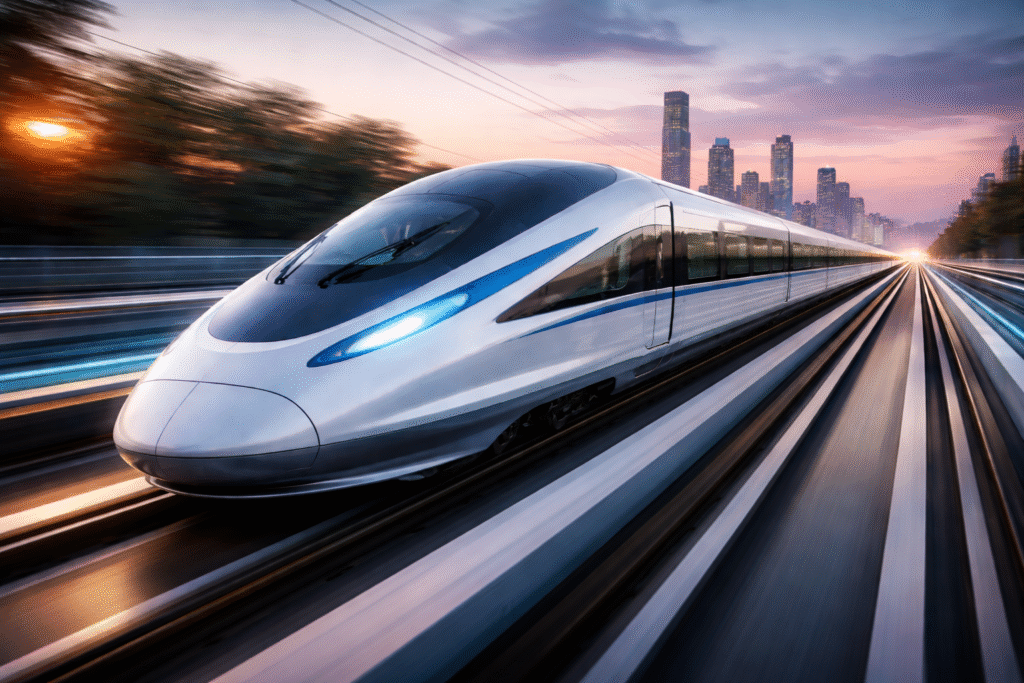
Chinese Fastest Train: The Record-Breaking Rail Revolution Transforming Global Transportation
Chinese fastest train technology is entering a new era, and the next generation of high-speed rail being tested in China may soon break every record in the history of land transportation.
For decades, trains have symbolized progress, efficiency, and engineering excellence. Yet the newest Chinese high-speed rail projects are pushing this vision further than anyone imagined. Engineers are designing trains capable of speeds that once belonged only to aircraft.
This technological leap is not just about speed. It represents a transformation in infrastructure, energy efficiency, economic mobility, and global transportation systems.
In this article, we will explore how China is developing the fastest train in the world, the technology behind it, the potential impact on the global transport industry, and why this innovation may redefine how humanity moves across continents.
Why China Is Investing Heavily in the Future of High-Speed Rail
Over the last two decades, China has built the largest high-speed rail network on the planet. With tens of thousands of kilometers of dedicated tracks, the country already operates some of the fastest and most efficient passenger trains ever created.
But China’s ambitions go far beyond maintaining leadership.
The nation aims to develop the next generation of ultra-high-speed trains capable of surpassing current technological limits.
The motivations behind this massive investment include:
- Reducing dependence on short-haul air travel
- Boosting economic integration between cities
- Lowering carbon emissions in transportation
- Strengthening global technological leadership
- Exporting advanced rail technology worldwide
These objectives make high-speed rail a strategic pillar of China’s long-term development.
The New Chinese Train That May Break All Speed Records
Several cutting-edge projects are currently being tested, but the most impressive involves a new generation of ultra-fast trains capable of reaching speeds above 600 km/h (373 mph).
To put this into perspective, commercial airplanes during takeoff travel at similar speeds.
This remarkable performance is possible thanks to a combination of technologies, including magnetic levitation systems, aerodynamic design, advanced materials, and intelligent control systems.
If fully implemented at scale, this innovation could become the fastest ground transportation system ever used for regular passenger travel.
How Fast Can the New Chinese Train Actually Go?
Traditional high-speed trains typically operate between 250 km/h and 350 km/h.
China’s newest experimental trains aim to operate at:
- 600 km/h in commercial conditions
- Even higher speeds during testing
- Long-distance travel times comparable to flights
At these speeds, traveling between major cities could become dramatically faster.
For example, a journey that currently takes four hours might be reduced to less than two.
The Technology Behind the Record-Breaking Train
The new Chinese rail systems rely on some of the most sophisticated engineering solutions ever developed for transportation.
Magnetic Levitation (Maglev) Systems
One of the most revolutionary aspects is magnetic levitation technology.
Instead of wheels touching rails, the train floats slightly above the track using powerful magnetic fields. This eliminates friction, allowing unprecedented speeds and smoother travel.
The benefits include:
- Higher maximum speeds
- Lower mechanical wear
- Reduced noise levels
- Improved energy efficiency
Ultra-Aerodynamic Design
At speeds above 500 km/h, air resistance becomes the main obstacle to performance.
Chinese engineers are using advanced wind-tunnel testing and computational simulations to create extremely aerodynamic train designs.
Key design improvements include:
- Long, needle-shaped noses
- Smooth exterior surfaces
- Reduced turbulence around the train body
- Advanced airflow management
These innovations dramatically reduce drag and allow the train to maintain stability at extreme speeds.
Smart Control and Safety Systems
Operating trains at such high speeds requires incredibly sophisticated monitoring and control systems.
Modern Chinese rail projects use:
- Artificial intelligence monitoring systems
- Real-time track diagnostics
- Advanced braking technology
- Fully automated operational controls
Safety remains the top priority in every phase of testing and development.
How This Train Could Transform Global Transportation
The development of the world’s fastest train is not just an engineering milestone—it could reshape transportation worldwide.
If ultra-high-speed rail becomes widely adopted, it may dramatically change how people travel between cities.
Short Flights Could Become Obsolete
High-speed trains already compete with airplanes for trips under 1,000 kilometers.
If trains reach consistent speeds near 600 km/h, rail travel could replace many domestic flights.
Passengers would benefit from:
- Shorter total travel times
- No long airport security procedures
- More convenient city-center stations
- Lower environmental impact
Massive Economic Impact
High-speed rail networks stimulate economic growth by connecting cities more efficiently.
Regions linked by ultra-fast trains often experience:
- Higher tourism activity
- Increased business mobility
- Stronger regional integration
- Faster logistics and commerce
This is one reason governments worldwide are closely observing China’s new rail technologies.
Common Myths About Ultra-High-Speed Trains
Despite their impressive capabilities, several misconceptions surround the world’s fastest trains.
Myth 1: High-Speed Trains Are Less Safe
In reality, modern high-speed rail systems are among the safest transportation methods available.
Dedicated tracks, automated monitoring, and advanced safety systems dramatically reduce accident risks.
Myth 2: They Consume More Energy Than Planes
High-speed trains are typically far more energy efficient than aircraft, especially when transporting large numbers of passengers.
Myth 3: The Technology Is Too Expensive to Scale
While infrastructure costs are high, the long-term economic benefits often outweigh the initial investment.
Many countries view high-speed rail as a strategic national asset.
China’s Strategy to Export High-Speed Rail Technology
China is not only building the fastest trains for domestic use.
The country is also positioning itself as a major exporter of high-speed rail technology.
Chinese companies are already involved in rail projects across multiple regions, including:
- Southeast Asia
- Middle East
- Europe
- Africa
If the new generation of ultra-fast trains proves successful, it could further strengthen China’s position as a global transportation technology leader.
What the Future of High-Speed Rail May Look Like
The race for faster trains is only beginning.
Researchers around the world are exploring even more ambitious technologies, including:
- Vacuum tube transport systems
- Hyperloop-style infrastructure
- Autonomous high-speed rail networks
- Fully electric ultra-efficient transportation corridors
China’s new record-breaking train represents a major step toward that future.
It demonstrates that the limits of ground transportation are still far from being reached.
FAQ: Frequently Asked Questions About the World’s Fastest Train
What is the fastest train currently being developed in China?
China is developing next-generation maglev trains capable of reaching speeds around 600 km/h, which could make them the fastest operational trains in the world.
How does a maglev train work?
Maglev trains use powerful magnetic fields to lift the train slightly above the track, eliminating wheel friction and allowing extremely high speeds.
Will ultra-fast trains replace airplanes?
They may replace many short-distance flights, particularly routes under 1,000 kilometers where trains can offer faster door-to-door travel times.
Is high-speed rail environmentally friendly?
Yes. High-speed trains generally produce far fewer carbon emissions per passenger compared to airplanes and cars.
When could the new Chinese train enter commercial service?
Some prototypes are already being tested. Large-scale commercial deployment may occur within the next decade, depending on infrastructure development.
Conclusion: A New Era of Transportation Is Approaching
The development of China’s record-breaking high-speed train marks one of the most exciting moments in modern transportation engineering.
By combining magnetic levitation, aerodynamic innovation, and intelligent control systems, engineers are pushing the boundaries of what ground travel can achieve.
If these technologies become widely adopted, the way people move between cities could change dramatically.
Travel times may shrink, economies may become more connected, and transportation may become cleaner and more efficient.
The train of the future is no longer a distant concept.
It is already accelerating down the tracks—and it may soon redefine the speed of the modern world.
COPYRIGHT NOTICE.

This video is embedded on YouTube and is licensed under the    CREATIVE COMMONS    License   (CC BY),   which    P  E   R   M   I   T   S   its reuse.

CREDIT TO THE ORIGINAL AUTHOR   , as required by the license.