
ARTICLE IN ENGLISH –
CHECK OUT THE VIDEO –
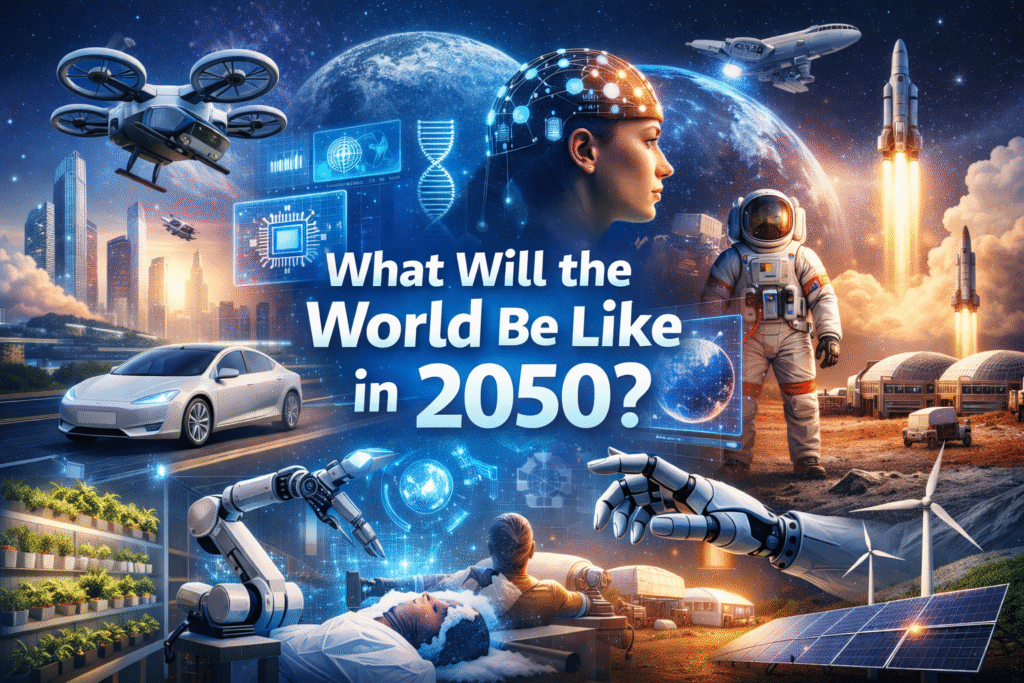
The World in 2050. 10 Technological Transformations That Could Redefine Humanity
The world in 2050 will likely be shaped by technological innovations that are already emerging today. Artificial intelligence, biotechnology, quantum computing, and sustainable energy are evolving rapidly and may transform how we live, work, travel, and interact with the planet.
For scientists, economists, and technology leaders, the coming decades represent one of the most important periods of transformation in human history. The convergence of digital, biological, and physical technologies is expected to create new industries, redefine global economies, and challenge traditional concepts of society.
In this in-depth guide, we explore 10 technological transformations that could dramatically reshape humanity by 2050. More importantly, we analyze how these innovations may impact everyday life, global markets, and the future of civilization.
Why 2050 Is a Critical Milestone for Technological Evolution
The year 2050 often appears in scientific reports, economic forecasts, and climate studies as a pivotal milestone. By that time, global population is expected to approach 10 billion people, urbanization will intensify, and the demand for resources will increase dramatically.
Technology will not simply be a convenience—it will become essential for solving large-scale global challenges.
- Climate change mitigation
- Food and water security
- Healthcare accessibility
- Energy sustainability
- Urban infrastructure
Because of these pressures, technological innovation is accelerating at an unprecedented pace.
10 Technological Transformations That May Define the World in 2050
1. Artificial Intelligence Becoming a Core Infrastructure
Artificial intelligence is rapidly moving beyond automation and data analysis. By 2050, AI systems could function as a fundamental infrastructure layer of society.
Instead of isolated tools, AI may coordinate entire ecosystems:
- Transportation networks
- Healthcare diagnostics
- Urban planning
- Energy distribution
- Financial systems
Advanced AI models could assist governments in decision-making, optimize supply chains, and enable predictive public services.
2. Personalized Medicine and Genetic Engineering
One of the most revolutionary developments expected by 2050 involves biotechnology and genetic science. Advances in gene editing technologies may allow doctors to prevent or even eliminate certain inherited diseases.
Healthcare could shift from reactive treatment to predictive and personalized medicine.
Possible developments include:
- Gene therapies tailored to individual DNA
- Early disease detection using AI diagnostics
- Lab-grown organs for transplant
- Precision drug treatments
This shift may dramatically increase life expectancy and reduce healthcare costs over time.
3. Fully Autonomous Transportation Systems
Transportation may look radically different by mid-century. Autonomous vehicles, intelligent traffic networks, and advanced mobility platforms could eliminate many of today’s transportation inefficiencies.
Future mobility systems may include:
- Self-driving electric vehicles
- Autonomous cargo logistics
- Urban air mobility (flying taxis)
- AI-controlled public transport
The result could be safer roads, faster logistics, and dramatically reduced traffic congestion.
4. Quantum Computing Transforming Scientific Discovery
Quantum computing remains in its early stages today, but it has the potential to revolutionize entire industries.
Unlike classical computers, quantum machines can process complex calculations exponentially faster in certain scenarios.
By 2050, quantum computing could enable breakthroughs in:
- Drug discovery
- Climate modeling
- Cryptography
- Material science
- Advanced simulations
These capabilities may unlock scientific discoveries that are currently impossible with traditional computing power.
5. Sustainable Energy Dominating Global Power Systems
Energy transformation will be one of the most critical developments shaping the world in 2050.
Renewable energy technologies such as solar, wind, and next-generation batteries are rapidly improving in efficiency and cost.
Future energy systems may include:
- Ultra-efficient solar panels
- Grid-scale energy storage
- Green hydrogen fuel
- Small modular nuclear reactors
A fully renewable global energy infrastructure could significantly reduce carbon emissions and stabilize long-term energy supply.
6. Smart Cities Powered by Integrated Digital Infrastructure
Urban environments are expected to undergo a technological transformation. Smart cities will integrate sensors, data analytics, and artificial intelligence to optimize urban life.
Key features of smart cities may include:
- AI-managed traffic systems
- Energy-efficient buildings
- Autonomous public transportation
- Advanced waste and water management
The goal is to create cities that are not only more efficient but also more sustainable and livable.
7. Space Economy and Off-Earth Industries
The commercialization of space is accelerating rapidly. Private companies and national space agencies are investing billions into lunar exploration, satellite infrastructure, and deep-space missions.
By 2050, the space economy could expand into areas such as:
- Asteroid mining
- Lunar industrial bases
- Space-based solar power
- Interplanetary communication networks
These developments may open entirely new economic frontiers beyond Earth.
8. Advanced Robotics in Everyday Life
Robotics technology is becoming increasingly sophisticated and accessible. By 2050, robots may play a central role in industries, healthcare, agriculture, and household tasks.
Examples include:
- Medical surgical robots
- Autonomous farming systems
- Warehouse logistics robots
- Domestic assistant robots
Rather than replacing humans entirely, robotics is more likely to augment human capabilities.
9. Immersive Digital Worlds and Extended Reality
Virtual reality, augmented reality, and mixed reality are evolving toward immersive digital ecosystems often described as the next generation of the internet.
These environments may transform:
- Education and remote learning
- Professional collaboration
- Entertainment and gaming
- Digital commerce
In many industries, immersive technologies could reduce geographic barriers and redefine how people interact and work.
10. Advanced Climate Technologies
As climate challenges intensify, new technologies will play a critical role in mitigation and adaptation.
Innovations may include:
- Carbon capture systems
- Climate-resilient agriculture
- Ocean restoration technologies
- Advanced environmental monitoring
These solutions could help balance economic development with environmental sustainability.
Common Misconceptions About the Future of Technology
When discussing the world in 2050, popular media often promotes unrealistic or exaggerated scenarios. However, technological progress tends to be gradual, complex, and shaped by social, political, and economic factors.
Common misconceptions include:
- Technology evolving in isolation from society
- Instant global adoption of innovations
- Automation completely eliminating human work
- Technological solutions without ethical challenges
In reality, the future will likely involve a balance between human decision-making and technological advancement.
How These Technologies May Impact Daily Life
For individuals and businesses, these transformations could reshape everyday experiences in profound ways.
- Healthcare may become predictive and personalized
- Transportation could be safer and largely autonomous
- Work environments may rely heavily on digital collaboration
- Energy systems may become decentralized and renewable
These shifts may also create entirely new career paths, industries, and economic opportunities.
FAQ: The Future of Technology and the World in 2050
What will daily life look like in 2050?
Daily life may involve highly connected environments, AI-assisted services, personalized healthcare, and advanced transportation systems. Many routine tasks could be automated, allowing people to focus more on creative and strategic activities.
Will artificial intelligence replace most human jobs?
AI is expected to automate certain tasks, but historically technology tends to create new industries and professions. Many jobs will likely evolve rather than disappear completely.
Will humans live longer by 2050?
Advances in biotechnology, genetics, and personalized medicine may significantly increase life expectancy while improving quality of life.
Could space travel become common in the future?
While mass interplanetary travel is unlikely for the general population by 2050, commercial space activities such as tourism, satellite infrastructure, and research missions will likely expand.
What is the biggest technological challenge before 2050?
One of the biggest challenges will be balancing rapid technological innovation with ethical considerations, environmental sustainability, and global economic stability.
The World in 2050: A Future Defined by Innovation
The world in 2050 will not simply be a more advanced version of today. It will likely represent a profound transformation in how humanity interacts with technology, the environment, and each other.
Artificial intelligence, biotechnology, sustainable energy, and space exploration are converging to shape a future that once seemed like science fiction.
While uncertainties remain, one thing is clear: the coming decades will redefine the boundaries of human possibility. The societies that invest in knowledge, innovation, and responsible technology development today will play the most influential roles in shaping the world of tomorrow.
COPYRIGHT NOTICE.

This video has been embedded on YouTube and is licensed under  "CREATIVE  COMMONS"  (CC BY), WHICH ALLOWS ITS REUSE.

CREDITS TO THE ORIGINAL AUTHOR as required by the license.