
ARTICLE IN ENGLISH –
CHECK OUT THE VIDEO –
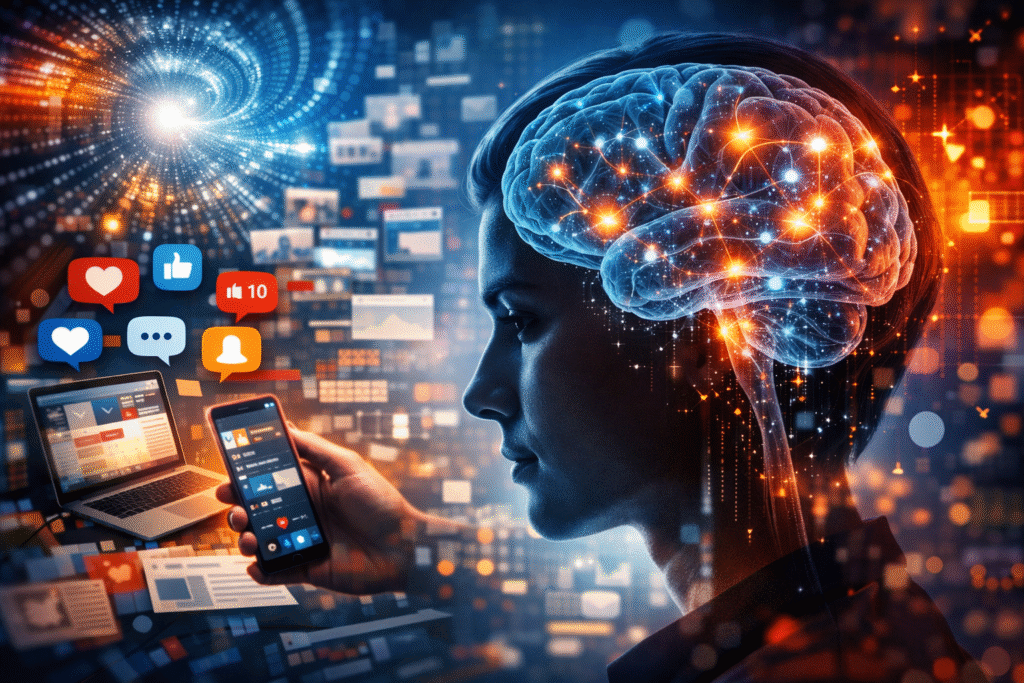
Digital hyperactivity is becoming an increasingly common phenomenon in modern life. In a world dominated by notifications, social media, and a constant flow of information, our minds are now operating at an accelerated pace, often beyond their natural processing capacity.
The problem is not only the amount of content available, but also the speed at which we are encouraged to consume everything at once. This raises an important question: what is happening to the human brain in the information age?
In this article, you will understand how technology is transforming the way we think, learn, and concentrate. You will also discover possible ways to preserve focus and mental health in an increasingly fast digital world.
The Accelerated Digital World
Over the past two decades, the internet has completely transformed the way we access information, work, and communicate. Today, anyone can access an almost infinite amount of content in just a few seconds.
Digital platforms are designed to maximize engagement. This means that algorithms, notifications, and constant updates keep users connected for longer periods of time.
As a result, our mental routine has become marked by rapid and continuous stimuli.
- Notifications appearing constantly
- Endless scrolling feeds
- Short and highly stimulating videos
- Information coming from multiple sources simultaneously
This environment creates the perfect conditions for the emergence of what is known as digital hyperactivity.
What Is Digital Mental Hyperactivity?
Digital mental hyperactivity can be defined as a constant state of cognitive stimulation caused by excessive interaction with digital devices and online platforms.
Unlike simple distraction, this phenomenon involves a deeper change in the way the brain processes information and maintains attention.
Main Characteristics of Digital Hyperactivity
- Increasing difficulty maintaining long periods of focus
- Constant need for new stimuli
- Anxiety when disconnected
- Rapid switching between multiple tasks
- Reduction in average attention span
Studies in cognitive neuroscience suggest that continuous exposure to fast digital stimuli may influence neural circuits related to attention and reward.
How Social Media Is Changing Our Brain
Social media is one of the main drivers of digital hyperactivity. These platforms are built using principles of behavioral psychology that encourage users to return frequently.
Likes, comments, and notifications function as small psychological rewards that reinforce the habit of continuing to scroll and interact.
The Role of Algorithms
Algorithms constantly analyze user behavior in order to deliver increasingly engaging and personalized content.
This creates highly efficient engagement cycles where each new piece of content is capable of capturing attention again.
Over time, the brain adapts to this pattern of constant stimulation.
Information Overload on the Internet
Never in history have humans had access to so much information. However, this abundance also brings an important side effect: cognitive overload.
The human mind has natural limits when processing data and making decisions. When these limits are exceeded, symptoms such as mental fatigue and difficulty concentrating may appear.
Signs of Information Overload
- Feeling mentally overwhelmed
- Difficulty prioritizing tasks
- Decreased productivity
- Superficial consumption of content
This phenomenon also explains why many people read more content than ever before but retain less information.
Digital Dopamine and the Search for Stimulation
One of the most discussed concepts today is digital dopamine. Dopamine is a neurotransmitter associated with the brain’s reward system.
When we receive a notification or find something interesting online, the brain releases a small amount of dopamine.
This creates a brief feeling of pleasure that encourages the behavior of searching for new stimuli again.
Why Are Digital Stimuli So Addictive?
- Fast and unpredictable rewards
- Constant novelty in content
- Instant social interaction
- Immediate feedback
These elements create a highly stimulating environment that can lead to excessive technology use.
Impact on Concentration and Productivity
One of the most visible effects of digital hyperactivity is the reduction of deep concentration.
Complex work, long study sessions, and creative activities require sustained periods of focus — something that is becoming increasingly rare in the modern digital environment.
Common Consequences
- Reduced productivity
- Frequent interruptions
- Difficulty finishing tasks
- Increased procrastination
The issue is not only technology itself, but how it structures and competes for our attention.
The Future of the Human Mind
The relationship between the brain and technology will continue evolving in the coming decades.
Experts believe that the human mind will gradually adapt to increasingly digital environments.
However, there is also growing concern about maintaining a balance between connectivity and mental health.
Possible Future Scenarios
- Education focused on attention management
- New practices for improving focus and concentration
- More conscious technology design
- Greater appreciation of deep thinking
These changes may redefine how we learn and work in the future.
How to Recover Focus in the Digital Age
Despite these challenges, there are effective strategies to reduce the impact of digital hyperactivity.
Practices That Help Restore Concentration
- Reduce unnecessary notifications
- Set specific times for social media use
- Create interruption-free work periods
- Practice deep reading
- Establish regular offline moments
Small habit changes can produce significant improvements in attention quality.
Education and Technology in the Future
Education will also need to adapt to this new digital context.
Teaching only content will no longer be enough. It will be essential to develop cognitive skills related to attention management, critical thinking, and information filtering.
These abilities will become fundamental for navigating a world increasingly saturated with data.
Frequently Asked Questions About Digital Hyperactivity
What is digital hyperactivity?
Digital hyperactivity is a state of constant mental stimulation caused by excessive use of digital devices and continuous exposure to online information.
Is technology really changing our brain?
Research suggests that the brain can adapt to digital stimulation patterns, influencing areas related to attention, memory, and decision-making.
Can social media affect concentration?
Yes. Frequent social media use can fragment attention and reduce the ability to maintain deep focus on complex tasks.
How can digital hyperactivity be reduced?
Some strategies include limiting notifications, establishing social media schedules, and creating interruption-free work periods.
Is digital hyperactivity a global issue?
Yes. As internet access expands worldwide, the effects of information overload are becoming increasingly common.
Conclusion: Balance Will Be the Key to the Future Mind
Digital hyperactivity represents one of the major cognitive challenges of the information age. Never before have we been so connected — and at the same time so exposed to constant stimulation.
Understanding how technology influences our brain is the first step toward developing a healthier and more balanced relationship with the digital world.
In the future, the most valuable skill may not be accessing information, but controlling our own attention in the middle of endless stimuli.
In a world where everything competes for our minds, the ability to focus may become one of the most important skills of the 21st century.
COPYRIGHT NOTICE.

This video has been embedded on YouTube and is licensed under the Creative Commons License (CC BY), which permits its reuse.

Credit to the original author, as required by the license.