
ARTICLE IN ENGLISH –
CHECK OUT THE VIDEO –
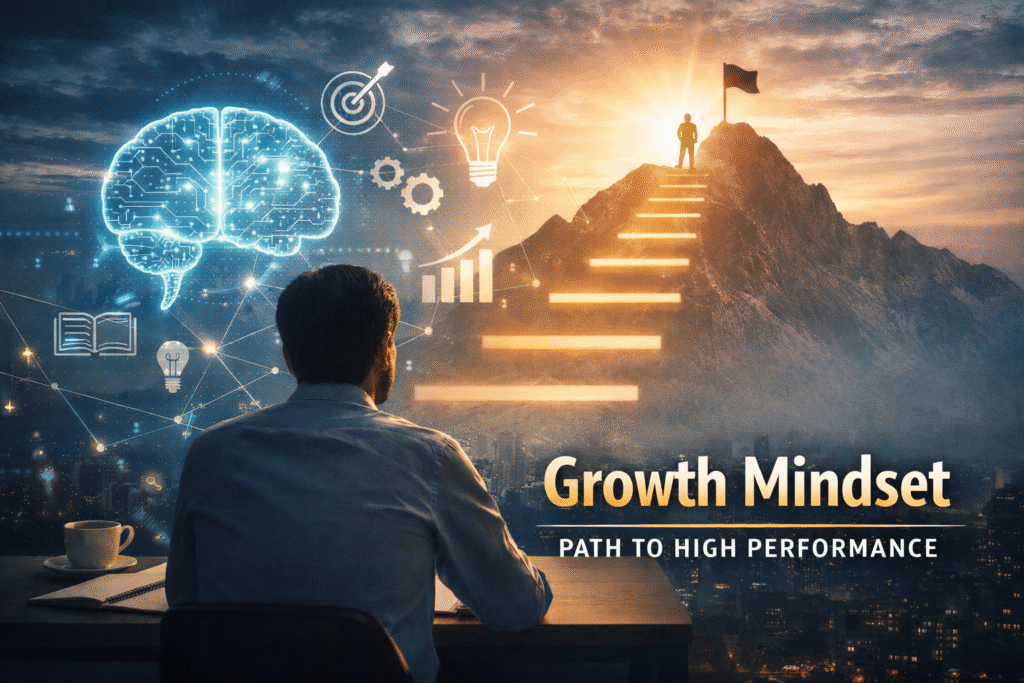
Growth Mindset: How to Develop a High-Performance Mentality
Growth mindset is the foundation of every high-performance mentality. In a world driven by constant change, those who believe they can evolve outperform those who believe their abilities are fixed. The difference between stagnation and sustained success often begins in the way we interpret challenges, failure, and effort.
This article delivers a deep, practical, and evidence-based guide on how to develop a growth mindset and build a true high-performance mentality — applicable to career, business, education, and personal life.
What Is a Growth Mindset — And Why Does It Matter?
The concept of growth mindset, popularized by psychologist Carol Dweck, refers to the belief that skills, intelligence, and abilities can be developed through effort, learning, and persistence.
In contrast, a fixed mindset assumes that talent and intelligence are static traits. This subtle difference produces radically different outcomes over time.
Growth Mindset vs. Fixed Mindset: Key Differences
- Challenges: Growth mindset embraces them; fixed mindset avoids them.
- Failure: Seen as feedback vs. seen as proof of inadequacy.
- Effort: Viewed as the path to mastery vs. seen as a sign of weakness.
- Criticism: Used as improvement data vs. taken personally.
- Success of others: Inspiring vs. threatening.
From a performance psychology perspective, individuals with a growth mindset develop stronger resilience, better problem-solving skills, and higher long-term achievement rates.
How Does a High-Performance Mentality Really Work?
A high-performance mindset goes beyond motivation. It combines cognitive flexibility, emotional regulation, strategic effort, and disciplined habits.
Professionals operating at high levels — athletes, entrepreneurs, executives — consistently demonstrate three internal patterns:
1. They Redefine Failure
Failure is processed as data, not identity. Instead of saying “I’m not good at this,” they ask, “What does this result teach me?”
2. They Focus on Process Over Ego
High performers commit to improvement systems: deliberate practice, feedback loops, skill stacking, and measurable progress.
3. They Build Mental Resilience
Stress is inevitable. What differentiates them is the ability to recover quickly and maintain clarity under pressure.
How to Develop a Growth Mindset in Practice
Understanding the concept is not enough. Developing a growth mindset requires intentional behavioral changes.
Reframe Your Internal Dialogue
Language shapes cognition. Replace limiting narratives with developmental ones:
- Instead of: “I can’t do this.”
- Say: “I can’t do this yet.”
This simple shift reinforces neuroplasticity — the brain’s ability to reorganize itself through learning.
Adopt Deliberate Practice
High performance is built on structured improvement, not repetition alone. Deliberate practice involves:
- Clear skill targets
- Immediate feedback
- Focus on weaknesses
- Incremental difficulty
This approach accelerates mastery far more effectively than passive repetition.
Seek Constructive Discomfort
Growth lives outside comfort zones. Intentionally exposing yourself to challenging tasks expands cognitive and emotional capacity.
For example, public speaking, learning a new language, or leading a complex project can significantly increase confidence and competence over time.
Common Myths About Growth Mindset
“Positive Thinking Is Enough”
A growth mindset is not blind optimism. It requires strategic effort, disciplined execution, and accountability.
“Some People Are Naturally High Performers”
While talent exists, sustained excellence depends on habits, mental conditioning, and adaptability.
“Failure Means I’m Not Capable”
In reality, repeated exposure to difficulty strengthens neural pathways related to problem-solving and resilience.
What Habits Strengthen a High-Performance Mindset?
Building a mindset for success requires consistency. The following habits compound over time:
Daily Reflection
- What worked today?
- What can improve tomorrow?
- What lesson did I learn?
Goal Decomposition
Break large objectives into actionable micro-goals. This increases clarity and reduces cognitive overload.
Feedback Culture
Invite structured feedback from mentors, peers, or supervisors. External perspectives accelerate growth.
Emotional Regulation Techniques
Practices like mindfulness, controlled breathing, and journaling enhance mental resilience and decision-making.
Why Growth Mindset Drives Career and Business Success
In competitive markets, adaptability is more valuable than static knowledge. Organizations increasingly prioritize professionals who demonstrate learning agility and strategic thinking.
A growth mindset directly influences:
- Leadership development
- Innovation capacity
- Team collaboration
- Conflict management
- Long-term career advancement
From a commercial perspective, individuals who cultivate a high-performance mentality become more valuable assets — whether as employees, entrepreneurs, or consultants.
Can Anyone Truly Develop a Growth Mindset?
Yes — but it requires awareness and structured effort.
Neuroscience confirms that the brain remains adaptable throughout adulthood. However, transformation depends on consistent cognitive reframing and behavioral practice.
The process often follows three stages:
1. Awareness
Recognizing fixed patterns in your thinking.
2. Intervention
Actively replacing limiting beliefs with growth-oriented strategies.
3. Reinforcement
Repeating new behaviors until they become automatic.
FAQ – Growth Mindset and High Performance
What is the difference between growth mindset and high-performance mindset?
A growth mindset is the belief that abilities can be developed. A high-performance mindset applies that belief through disciplined habits, resilience, and strategic execution.
How long does it take to develop a growth mindset?
It varies by individual, but noticeable cognitive shifts can occur within weeks when deliberate practice and reflection are consistent.
Can adults change from a fixed mindset?
Yes. Neuroplasticity allows adults to reshape thought patterns, provided they actively challenge limiting beliefs.
Does growth mindset guarantee success?
It does not guarantee outcomes, but it significantly increases the probability of sustained improvement and adaptability.
How can leaders encourage a growth mindset in teams?
By rewarding effort, promoting learning from mistakes, encouraging feedback, and modeling adaptive behavior.
Conclusion: The Strategic Advantage of a Growth Mindset
Developing a growth mindset is not a motivational trend — it is a strategic advantage in an increasingly complex world.
A high-performance mentality transforms how you interpret setbacks, pursue mastery, and respond to pressure. Over time, these internal shifts compound into measurable external results: stronger careers, better leadership, improved resilience, and expanded opportunities.
The future belongs to those who remain adaptable. By intentionally cultivating a mindset for growth, you position yourself not only to compete — but to evolve continuously in any environment.
COPYRIGHT NOTICE.

This video was embedded from YouTube and is licensed under Creative Commons (CC BY), which permits its reuse.

Credit to the original author as required by the license.
envlohjhmvlwxruqmzfoqidqzsiwqh