
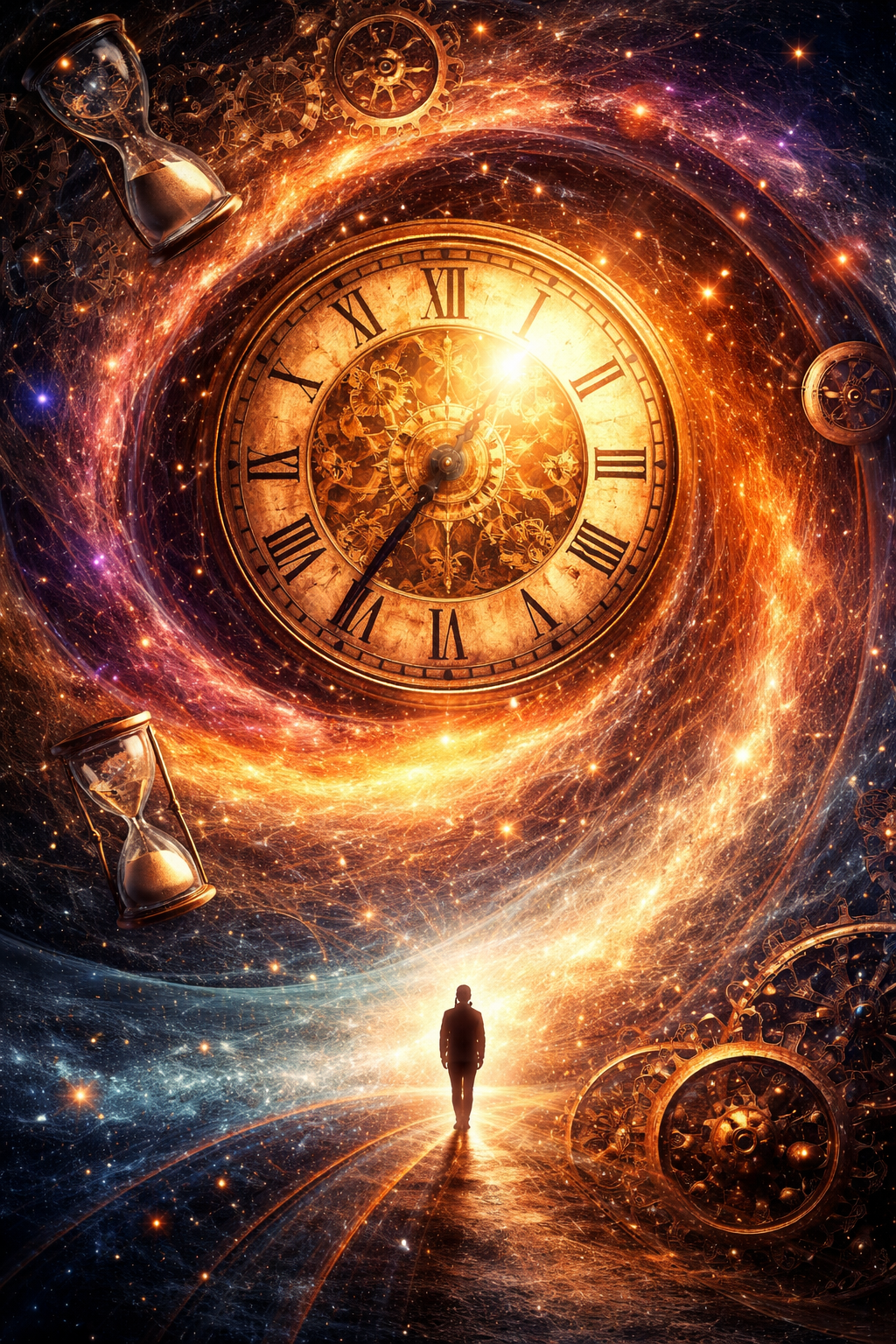
What Is Time? A Question That Has Fascinated Humanity for Centuries
Time is one of the most fundamental concepts in human existence. We measure it, schedule our lives around it, and often feel controlled by it. Yet, when we stop to ask a seemingly simple question — what is time? — the answer becomes surprisingly complex.
Is time a real, physical entity that flows independently of us? Or is it merely a mental construct, created by the human brain to organize reality? Scientists, philosophers, and thinkers across civilizations have struggled with this question, and even today, there is no single, definitive answer.
The Classical View of Time: A Universal Flow
For centuries, time was understood as something absolute and universal. This idea was famously defended by Isaac Newton, who believed that time flowed at a constant rate everywhere in the universe, regardless of events or observers.
In this classical perspective, time exists independently of matter and space. It moves forward like an invisible river, carrying all events with it. Past, present, and future are clearly defined, and the present moment is shared by everyone.
This intuitive view of time still dominates everyday life and language. We talk about “saving time,” “losing time,” or “time passing,” as if it were a tangible substance.
Einstein and the Collapse of Absolute Time
The idea of absolute time was dramatically challenged in the early 20th century by Albert Einstein. With his theory of relativity, Einstein demonstrated that time is not universal or fixed.
According to relativity, time depends on the observer’s speed and gravitational environment. Clocks tick at different rates depending on how fast they are moving or how close they are to massive objects. This phenomenon, known as time dilation, has been confirmed by countless experiments.
In Einstein’s universe, time is deeply intertwined with space, forming a four-dimensional structure called spacetime. There is no single, objective “now” shared by everyone.
The Shocking Implications of Relativity
If time can slow down or speed up, then it cannot be a simple, flowing background. Instead, time behaves more like a dimension — similar to space — where past, present, and future may coexist.
This leads to the unsettling idea that the future might already “exist” in some sense, just as distant locations exist even if we cannot see them.
Does Time Really Flow, or Is That an Illusion?
One of the most fascinating questions in modern physics is whether time actually flows at all. Many physicists argue that the sensation of time moving forward is not a fundamental feature of reality.
Instead, they suggest that all moments — past, present, and future — exist equally in a “block universe.” In this view, time does not move; we do.
The feeling of flow may arise from how human consciousness experiences events, rather than from time itself.
The Arrow of Time and the Role of Entropy
If time does not truly flow, why do we experience a clear direction from past to future?
The most widely accepted explanation involves the concept of entropy. In physics, entropy measures disorder. The second law of thermodynamics states that entropy tends to increase over time.
This increase in entropy creates what is known as the arrow of time. We remember the past because it was more ordered, and we cannot remember the future because it has not yet reached higher entropy states.
Why We Can’t Reverse Time
On a microscopic level, many physical laws are time-symmetric. However, on a macroscopic scale, increasing entropy makes time appear irreversible.
This explains why broken glasses do not spontaneously reassemble and why aging moves in only one direction.
The Human Perception of Time
Neuroscience reveals that time perception is deeply subjective. The brain does not possess a single “clock.” Instead, it constructs time from memory, attention, and sensory input.
Moments of danger may seem to last longer, while enjoyable experiences can feel surprisingly brief. This suggests that time, as we experience it, is partially a mental illusion.
Is the Present Moment Real?
Some philosophers argue that the present is the only thing that truly exists. Others claim that the present is simply a psychological boundary created by consciousness.
From a physics perspective, there is no universal present — only local experiences of “now.”
Time in Quantum Physics: A Deeper Mystery
Quantum physics introduces even more puzzling questions about the nature of time. At the quantum level, time may not exist as a fundamental variable at all.
Some theories suggest that time emerges from more basic quantum relationships, rather than existing on its own.
If this is true, time could be an emergent property — a byproduct of deeper physical processes.
Is Time an Illusion After All?
So, does time exist, or is it an illusion?
The most honest answer is that time exists, but not in the way we intuitively believe. It is not a universal ticking clock, nor is it entirely imaginary.
Time appears to be a complex interplay between physical laws, entropy, and human perception. Its “flow” may be more about how we experience reality than about reality itself.
Why Understanding Time Changes Everything
Our concept of time influences how we think about life, death, free will, and the future. If the future already exists, what does that mean for choice and responsibility?
If time is emergent, then reality may be far more interconnected than we imagine.
These questions make time not only a scientific problem, but one of the most profound philosophical mysteries ever explored.
Frequently Asked Questions (FAQ)
What is time according to physics?
In modern physics, time is part of spacetime and is relative to the observer. It does not flow uniformly for everyone.
Does time exist without humans?
Physical processes would still occur, but the experience of time as we know it may depend on conscious observers.
Is time travel possible?
Forward time travel is supported by relativity through time dilation. Traveling backward in time remains highly speculative.
Why does time feel faster as we age?
This is linked to memory formation and routine. New experiences make time feel longer, while repetition compresses perception.
Conclusion: Time as the Greatest Mystery of All
Time governs our lives, yet resists simple definition. Science reveals that it is flexible, relative, and deeply connected to the structure of the universe.
Philosophy and neuroscience suggest that much of what we call time may be shaped by the mind itself.
Whether time is an illusion, an emergent phenomenon, or a fundamental dimension, one thing is certain: understanding time means understanding reality — and ourselves — at the deepest level.
AVISOS DE DIREITOS AUTORAIS.
Este vídeo foi incorporado do YouTube e está licenciado sob “CREATIVE COMMONS” (CC BY), o que permite sua reutilização.
Créditos ao autor original conforme exigido pela licença.