
ARTICLE IN ENGLISH –
CHECK OUT THE VIDEO –
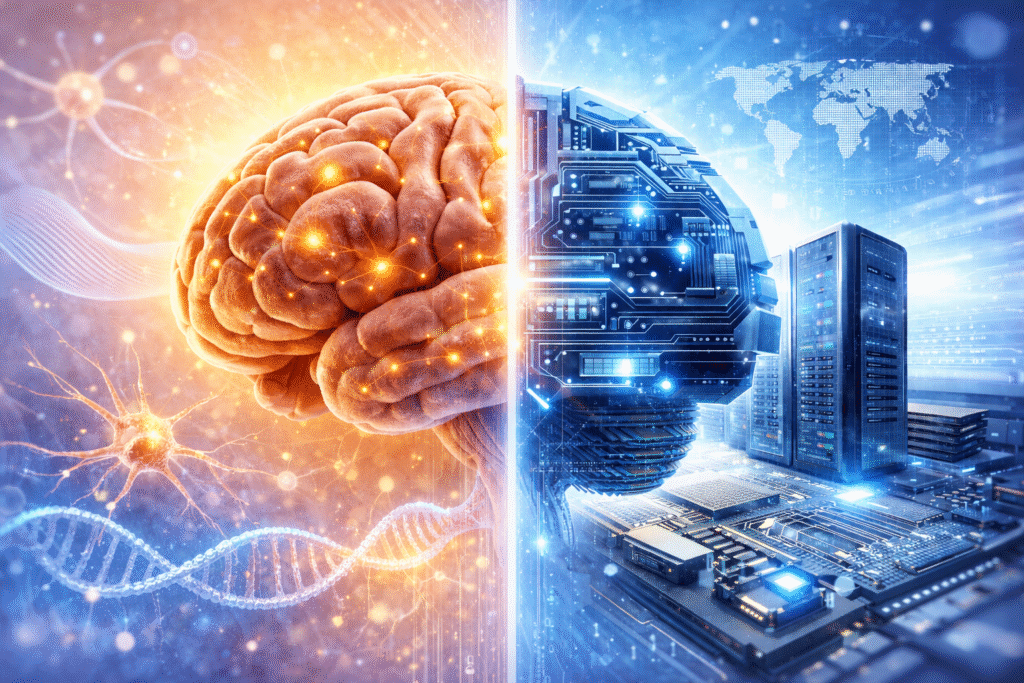
The human brain: the biological machine that surpasses any supercomputer
The human brain is often compared to modern supercomputers — yet this comparison barely captures its true complexity. While machines fill entire facilities and consume megawatts of power, the brain operates with extraordinary efficiency inside a 1.4-kilogram biological structure.
Understanding why the human brain surpasses supercomputers is not just a scientific curiosity. It reshapes how we view artificial intelligence, cognitive potential, technological limits, and the future of innovation itself.
This in-depth analysis explores brain processing power, energy efficiency, adaptability, intelligence, and the real-world implications of comparing biological and artificial systems.
How does the human brain actually work?
The human brain contains approximately 86 billion neurons interconnected through trillions of synapses. Each neuron acts as a biological processor, transmitting electrical and chemical signals at remarkable speed.
Massively parallel processing: the ultimate advantage
Unlike traditional computers that rely largely on sequential processing, the brain operates through massively parallel computation. Millions of processes occur simultaneously.
- Instant facial recognition
- Contextual language interpretation
- Emotion-driven decision making
- Real-time sensory integration
- Continuous adaptive learning
Supercomputers excel at structured numerical calculations. The brain excels at contextual interpretation, ambiguity resolution, and creative synthesis.
Human brain vs supercomputer: who processes more data?
Modern supercomputers can reach exascale performance, executing quintillions of floating-point operations per second (exaflops). In raw arithmetic speed, machines clearly dominate.
However, comparing FLOPS to brain function is fundamentally flawed. The brain does not compute like a digital processor. It encodes information through distributed neural patterns, dynamic feedback loops, and probabilistic signaling.
Scientific estimates suggest:
- Memory storage equivalent between 1 and 2.5 petabytes
- Ultra-efficient energy consumption
- Self-optimizing neural reconfiguration
- Low-latency pattern recognition
Supercomputers calculate. The brain interprets, predicts, and imagines.
Energy efficiency: the decisive factor
One of the most overlooked comparisons between the human brain and supercomputers is energy consumption.
The brain operates on approximately 20 watts of power — comparable to a small light bulb. In contrast, high-performance computing systems may require megawatts of electricity.
Why this matters
- Extreme computational efficiency per watt
- Sustainable biological optimization
- Continuous 24/7 operation
- Self-repair and structural adaptation
From an engineering standpoint, replicating this energy-to-intelligence ratio remains one of the greatest challenges in computer science and artificial intelligence research.
Neuroplasticity: a self-upgrading system
Unlike programmed machines, the human brain continuously reorganizes itself. This phenomenon, known as neuroplasticity, enables learning, adaptation, and recovery.
Practical implications of neuroplasticity
- Learning new languages and skills
- Recovery after neurological injury
- Cognitive performance improvement
- Professional skill adaptation
Supercomputers require external updates. The brain updates itself.
Can artificial intelligence surpass the human brain?
Artificial intelligence has advanced rapidly, achieving remarkable breakthroughs in image recognition, natural language processing, autonomous driving, and predictive analytics.
Yet AI systems depend on structured datasets, training parameters, and algorithmic architectures. The human brain can generalize from minimal data, imagine hypothetical scenarios, and generate abstract meaning.
Key structural differences
- AI requires massive labeled datasets
- The brain learns from limited exposure
- AI lacks consciousness and subjective experience
- The brain integrates emotion with reasoning
Even the most advanced neural networks remain specialized tools rather than self-aware cognitive systems.
Common misconceptions about brain vs computer comparisons
1. Intelligence equals calculation speed
Human intelligence includes emotional judgment, ethical reasoning, and contextual awareness.
2. Processing power defines superiority
Raw speed does not equal adaptive intelligence.
3. AI replication equals consciousness
Simulating behavior is not the same as generating subjective awareness.
Technological and economic implications
Studying the human brain inspires breakthroughs in:
- Neuromorphic computing
- Advanced neural networks
- Brain-computer interfaces
- Neurotechnology and digital health
Global investment in AI and neuroscience research reaches billions of dollars annually. Understanding brain-inspired architectures influences industries ranging from healthcare to robotics and finance.
For professionals and decision-makers, grasping the distinctions between biological and artificial intelligence is strategically valuable.
Does the human brain still hold mysteries?
Despite major advances in neuroscience, fundamental questions remain unanswered.
- How does consciousness emerge?
- What defines subjective experience?
- How are long-term memories encoded precisely?
- What mechanisms generate creativity?
The incomplete understanding of these mechanisms reinforces a powerful conclusion: the human brain remains the most sophisticated system known to science.
Frequently Asked Questions (FAQ)
Is the human brain more powerful than a supercomputer?
In raw numerical calculations, supercomputers outperform the brain. In adaptive learning, creativity, and energy efficiency, the brain remains superior.
How much data can the human brain store?
Estimates range from 1 to 2.5 petabytes, though memory storage operates through dynamic neural encoding rather than fixed digital units.
Why is the human brain so energy efficient?
Because it uses electrochemical signaling and distributed parallel processing optimized through millions of years of evolution.
Can artificial intelligence become conscious?
There is currently no scientific evidence that AI systems possess consciousness or subjective awareness.
What makes the human brain unique?
Its combination of adaptability, emotional integration, abstract reasoning, and biological efficiency remains unmatched by any artificial system.
Conclusion: the ultimate frontier of intelligence
The human brain is not merely an organ — it is the most complex structure known in the observable universe.
Supercomputers will continue to evolve, achieving unprecedented levels of computational performance. Yet creativity, consciousness, adaptive reasoning, and energy efficiency still define the unique power of the human brain.
The future of technology may not depend solely on building faster machines, but on understanding and integrating the principles of the most advanced biological processor ever discovered.
COPYRIGHT NOTICE.

This video was embedded from YouTube and is licensed under Creative Commons (CC BY), which permits its reuse.

Credit to the original author as required by the license.